Here’s something about me you may not know. I’m a business entrepreneur but I also love to bake! And I’m always on the lookout for great recipes to try. The problem with baking – CALORIES! Because we try to eat reasonably healthy, I end up NOT baking as much as I’d like.
Sure I can freeze the goodies for another time. And of course, I can always alter the recipe for healthier low-calorie ingredients. But why? Why not just enjoy splurging on the good stuff every once in a while. Especially when it means creating wonderful family memories of Springtime traditions with my girls!
My daughters REALLY love baking too. It’s the measuring, the pouring, the mixing, the licking of the utensils. They love it all. So there are certain times of the year when I make a command level mommy decision and allow guilt-free baking to take place.
Tomorrow is St. Patrick’s Day, March 17! I’m one of those moms that love tradition and creating family memories though, through all my hard work, there’s all too often too little time left! It’s so cool to watch the kids as their faces light up when they see that we’re about to do something fun for an upcoming holiday.
And now that my kids are getting a bit older, I think it’s a good time to start finding some great family-friendly St. Patrick’s Day activities. Age appropriate, of course.
Now I have some traditions from my childhood that I carry forward to my own family, but in the grand scheme of things, there really aren’t that many to choose from. Maybe that’s why I’m so adamant about having those special traditions or activities in place for my own children to enjoy.
So when it comes to finding ideas for new family traditions and fun, I tend to be an internet junkie. I could surf the web for hours looking for free coloring sheets, various printable crafts, decoration ideas, fun holiday recipes, and other great ways to get my children excited and into the spirit of pretty much any holiday.
After some light planning (of course, I need to adjust my work schedule a bit), here are some of the fun things I’ve come up with for my family to enjoy this week.
After I taught my kids all about the history of Christmas and Santa Claus last December, I’ll now start the week by teaching my children about the history of St. Patrick’s day: St. Patrick, born in Britain during the 4th century, was kidnapped by Irish raiders when he was just a teenager. After 6 years of being held captive, he finally escaped and became a priest in Britain. Later he chose to return to Ireland as a missionary, spreading the teachings of Christianity to the pagans.
According to Irish folklore, he used a shamrock as a symbol to explain the concept of the Holy Trinity to the Irish. Despite opposition from pagan leaders, St. Patrick continued to spread God’s message, baptized newly converted Christians, and established monasteries, churches, and schools. He died on March 17th.
Since then, March 17th has become a day where people all over the world honor St. Patrick, but it has slowly become a celebration of Irish heritage – shamrocks, ethnic food, leprechauns, and wearing green. It’s only good that we managed to bring down our chicken feed cost. How could I otherwise have the money for all these activities…? And how could we have enjoyed our great cycling tour of Ireland last year…?
Since my children are still pretty little, they love Irish traditional music and doing various arts and crafts: Here’s one we made together this weekend. The girls had a blast with it! Although Faith did get a little carried away with her pot of gold! Ahhh…a girl after my own heart!
Rainbow Hands with a Pot of Gold
Supplies Needed:
Red, Yellow, Orange, Green, Blue, and Purple construction paper
Black construction paper
Background paper to glue the rainbow on
Cotton Balls
Glue
Glitter
Scissors
Pen or Marker
Instructions: Trace your child’s hand on each color of construction paper. Help them cut the handprints out. Then glue the hands onto a background sheet of paper in an arch like a rainbow, leaving some room at the bottom of each side for clouds.
For my older daughter (her hands were bigger) we used a larger sheet of white paper. She colored the sky light blue before gluing the rainbow hands on. They might even learn to speak a few words in a real Irish accent. Wouldn’t that be fun!?
For my two-year-old, we just used a light blue sheet of construction paper as the background page. Next glue some cotton balls at the end of each side of the rainbow to create clouds.
Cut the black construction paper into the shape of a pot. Glue it underneath the rainbow. Cut small gold coins out of extra yellow construction paper and glue them around the top of the pot.
Then add some dots of glue to the page wherever you like and sprinkle glitter over the glue. Wait a few minutes and then shake the excess glitter off the picture into a container or trash can.
If you want to learn more about the history of the Irish in America, and I’m sure that when my kids are older I’ll do that too with them, check out the PBS documentary “The Irish in America.”
Here are a few other artsy things to try
Free Coloring Pages
Shamrock Drawing – Practice drawing a shamrock. Just draw three hearts with the point of each heart meeting in the middle and add a stem.
Abstract Painting – Pick paint colors that represent St. Patrick’s Day. Then challenge your child to paint a picture using only those colors. You’ll be surprised what creative little minds can come up with.
Make a scented shamrock
Play with GREEN play dough – how many different green things can you make?
We LOVE playing games! Here’s one game we are sure to have fun with this week:
Leprechaun Tag – Pick a green or gold “treasure” item from your home or the toy box. Put on some running shoes and go outside. The Leprechaun gets to chase the other players, trying to get his/her hands on the “treasure” item while the players are passing the “treasure” back and forth to each other.
When the Leprechaun gets the “treasure” he/she gets to tag any person they choose to be the Leprechaun.
We also LOVE to eat! But my hubby and kids don’t like the traditional Corned Beef and Cabbage. So we’ll be trying these fun Irish food recipes that the Americans have gotten used to in honor of St. Patrick’s Day. This weekend Faith and I made Irish Brown Bread, together with Spring Sugar Cookies. Faith really had fun making it.
It’s supposed to be mixed with your hands rather than a mixer or fork. She was particularly thrilled with it when I poured the buttermilk into the dough mixture. It was very cold and gooey on her hands. But, while it was fun to make, it was definitely NOT a hit for us to eat. If you’ve never had Irish Brown Bread before, I’ll share that it’s very dense texture alcohol. This bread is sure to soak it all up!
And finally, DON’T forget to wear green. Especially YOU, the Irish in America! Once your children are aware of the concept to pinch whoever’s not wearing green, they’ll be watching YOU very closely on St. Patrick’s day.
For our family Christmas party this year (the one involving my Mom and siblings—one family Christmas party of many), we conducted a neighborhood food drive to benefit the Pennsylvania Food Bank.
We were aiming for a repeat of the year the homeless person crashed our party. Not a repeat of the event, of course, but of the mood and the lesson. It didn’t quite work out that way.
Two days before the party we distributed fliers in the neighborhood, telling people what we were doing and inviting them to leave donations in bags on their porches. That project was our first hint that the thing wasn’t going to go as planned.
Boy 12 was pissy the whole time as we walked from door to door spreading Christmas goodwill with our fliers. Because of our Irish ancestry, we decided to explain to our kids a little bit about Christmas being a 2-day feast in some countries.
The Irish Isle Restaurant and Bridget’s Pub
7843 Main Street
Middletown, Virginia 22645
Phone: (540) 868-9877 “A Taste of Ireland in the Shenandoah Valley”
The Irish Isle is located in historic Middletown, Virginia on Route 11 (Main Street) just 1/2 mile from the I-81 exit. They are one block north of the popular Wayside Theatre.
The owners, Brian, Philomena, and Tara Coughlan, are very pleased to be here in Middletown and to be able to preserve this beautiful historic building. This was originally the Middletown State Bank that was built in 1890. You will notice that the bank vault on the main level is now used as a server station with the original safe still in use inside.
The easiest way to begin is with a tin whistle. All you need is 6 fingers and a tin whistle. A lot of musicians start out playing tin whistle and some choose to explore other instruments such as flute, fiddle, uilleann pipes, button accordions, concertina, bodhrán, banjo, mandolin, guitar, or bouzouki. The tin whistle is small, portable, and it a good foundation for those who want to start learning Irish music.
We recommend that you begin with a tin whistle in the key of D. This is the ‘D’ above middle C on the piano. You will find other keys available and are divided into high and low whistles. The low whistles are in lower octaves. If you are a complete beginner you will find it easier to start with a high D whistle rather than a Low D whistle.
Thinking about visiting Ireland? Well, don’t forget to check out Limerick, a great historic city that boasts great rugby legends, offers sizzling food, and comes with interesting street art.
There’s always something going on in Limerick. The town’s riverside walks, revamped quays, and casual dining food scenes will steal your heart, that’s for sure!
Here are a few good reasons to visit Limerick:
Limerick’s Georgian grid When you think of Georgian architecture in Ireland, you’d probably think of Dublin, but the country has more to offer. The Georgian grid of Limerick (referred to as Newtown Pery) looks unfortunately for the larger part still like a crumbling wreck.
If you look a little deeper, however, you’ll come aware of its historic relevance, the quality, and its mouthwatering potential. Even the roughest corners echo the city’s heritage.
Come to Limerick and marvel at the dilapidated fanlights and iron balconies around Mallow Street, and set-pieces like the Crescent on O’Connell Street. Outside of Dublin, Limerick boasts the largest Irish collection of Georgian townhouses.
Newtown Pery was founded by the First Viscount Pery in Limerick’s old medieval quarter around the end of the 18th century, and though its demise is obvious, it’s definitely worth a visit.
King John’s Castle
The castle’s fat, fortified walls have functioned as a Limerick landmark since 1210, and a recent refurbishment (that cost almost €6 million) has put King John’s Castle right in the spotlight where it should be.
The castle now features interactive exhibitions, cool models, costumed actors, and spooky underground chambers that make the castle one of Limerick’s top attractions.
You can swoosh Norman swords, dress in historic costumes, shoot your small balls from miniature canons, and enjoy the most magnificent views of the city. King John’s Castle is an interesting reboot of an Irish heritage treasure.
St. Mary’s Cathedral (Bridge Street)
The Cathedral (officially named the Church of St. Mary the Virgin) is Limerick’s oldest building that’s still used on a daily basis. The cathedral is not on every tourist’s must-see list, but is absolutely worth a visit and radiates a solemn atmosphere.
You will enjoy the gorgeous stained glass panels that were used to teach religious topics in earlier days, the beautiful oak carvings (similar to Westminster Hall’s roof beams), the impressive chandeliers, the mysterious alcoves, and a beautiful mosaic triptych (carved by father of Padraig James Pearse).
Limerick City Gallery of Art (Carnegie Building, Pery Square)
Limerick City Gallery of Art (LCGA) is a leading Irish contemporary art gallery that features an impressive collection of Irish Art from the 18th, 19th, and 20th centuries in various media.
The Gallery’s Irish Art collection includes more than 800 works, and LCGA is also home to the Michael O’Connor International Poster Collection and the National Collection of Contemporary Drawing.
The Gallery additionally offers Irish and international artists the chance to display their work. The Gallery is housed in the historic Carnegie Building in People’s Park that went through a big redevelopment that was completed in 2012. LCGA boasts 650 square meters of exhibition space which is wheelchair accessible with wide doorways, a disabled toilet, and a lift.
Limerick’s Street Art Well, as we all know, art is not only found in galleries. The grittier side of Limerick makes a fine podium for street art, and you’ll be surprised to find the coolest pieces at the most unlikely spots.
You could, for example, take a look at a great painting by an Australian artist named ‘Smug’ of a bearded man with a Hello Kitty tattoo who’s gleaming out from a gable end, displayed just across from King John’s Castle.
Of course, street art isn’t every Limerick resident’s idea of great art, but this surely is a unique Limerick asset in the making. Street art can look quite charming against the city’s backdrop, and the work of local artists is definitely giving the city an excellent edge.
Rugby Legends Well, King John’s Castle is surely not the only Limerick fortress! The city’s Thomond Park is a legendary venue, and Limerick is the heartland of Munster Rugby.
You can enjoy a great tour of the stadium that will take you directly into the inner sanctum. Marvel at the success of the city’s famous rugby team that every year works with a number of charities to help them raise funds for a good cause. You’ll get the chance to go pitch-side or to check out Munster’s changing rooms.
Many of us claim Irish heritage, but also those who don’t are welcome at the Commodore John Barry Arts & Cultural Center. Feel free to enjoy the vibrant and warm Irish culture and benefit from the center’s facilities such as the elegant and spacious ballroom.
The Commodore John Barry Arts and Cultural Center—formerly known as the Philadelphia Irish Center/Commodore Barry Club—has had a long and storied history. Here are some of the highlights.
1905
The Pelham Auto Club is Built
“It was Pelham’s social institution, with billiards, a bowling alley, a dining room, a ballroom, card rooms, and a garage with a full-time mechanic.”
28 Sep 1936
Pelham Club Becomes First Home of Germantown Jewish Centre
The Centre leased the auditorium for $200 a month. “It was the largest auditorium in the city at that time and for many years after. It had a seating capacity of 750 at tables and 1,200 in chairs for lectures. This was the space we rented as our first home.”
In the northern portions of the Bronx, located just above Woodlawn cemetery and east of The Bronx’ Van Cortlandt Park, you will find a neighborhood called Little Ireland, New York City’s proud center of Irish culture and its people. This is where I grew up. Could it be more Irish-American anywhere else in the nation?
The neighborhood is actually called Woodlawn Heights but New Yorkers simply say Woodlawn, that’s how it is known. For many years, the neighborhood has been an important New York destination for the Irish exodus.
Woodlawn was originally populated by people of German descent, but today, the neighborhood is predominantly Irish in combination with quite a few Italian-Americans.
Woodlawn is the part of New York City where you will find the most 4-leaf clover insignias on buildings and storefronts across the city. Woodlawn has pretty definitive borders, but you’ll find the local Irish community on either side of McLean Avenue, the city line between Yonkers and New York City.
The Delaware Valley Irish Hall of Fame (DVIHOF) seeks to honor those in the Irish community who play a role in preserving and continuing the Irish traditions. The awards are presented annually.
For generations, Irish immigrants were coming to Gaelic Park, the Bronx, to play all types of sports. Gaelic Park is a relatively small, bur cozy 2,000-seats stadium that sits at 240th Street and Broadway in Riverdale, the Bronx.
Gaelic Park has always much more than merely a sports field. This is the place where the Irish of New York City went to meet their potential spouses, to make connections, to talk to their old country friends or to make new ones.
It all started in the early 1920’s when Irish players ferociously battles their Gaelic football matches, a sort of blend rugby and soccer, and Hurling, a typical Irish sport that contains elements of lacrosse, field hockey, and baseball. This all was happening right in the middle of the American alien landscape of concrete, but for the Irish, Gaelic Park was a bit of haven.
In earlier days, this place was bustling with activity. There were many teams here, so many players, but they have removed all those things, and where at one day rickety wooden stands were teetering toward the skies, there are now only a few scattered picnic tables. The Irish bands and the beer sellers have long been absent….

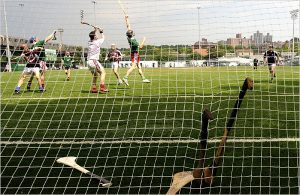 For generations, Irish immigrants were coming to Gaelic Park, the Bronx, to play all types of sports. Gaelic Park is a relatively small, bur cozy 2,000-seats stadium that sits at 240th Street and Broadway in Riverdale, the Bronx.